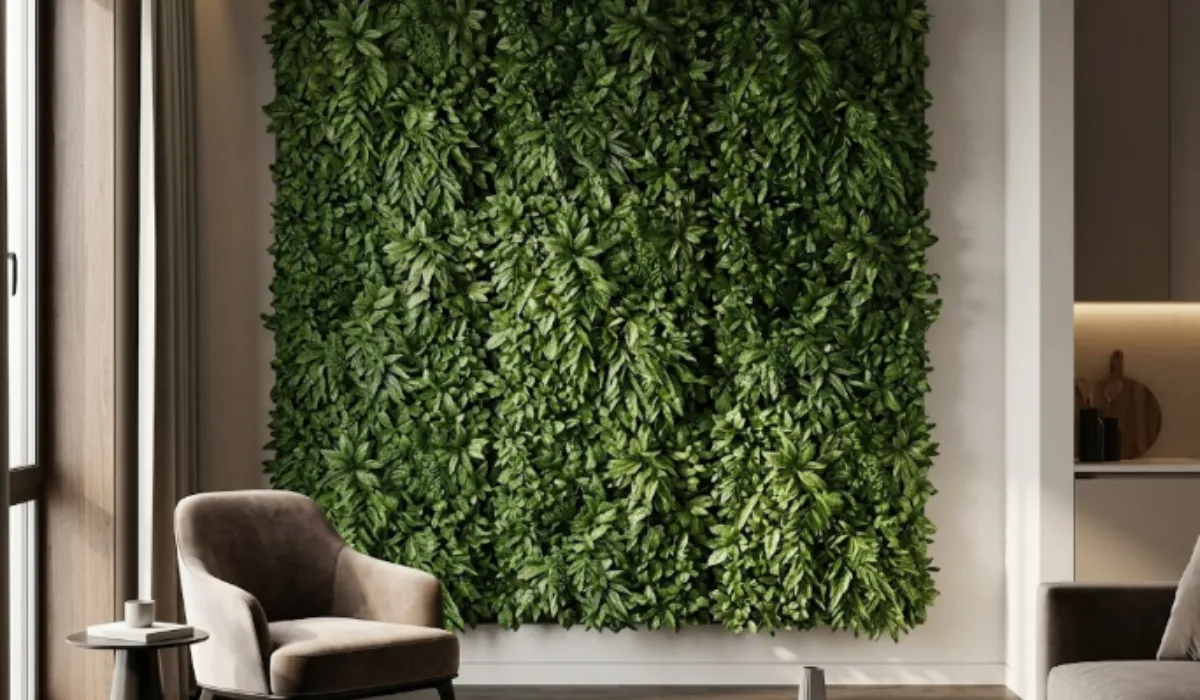
Define a vertical garden as a mounted arrangement of plants or plant-like surfaces designed to occupy vertical planes rather than horizontal ground. Define maintenance-free greenery as plant décor that requires minimal to no watering, pruning, or ongoing horticultural care. Define artificial foliage panels as engineered sheets or modules made from synthetic leaves and backing materials that mimic living greenery while eliminating regular plant care.
This article explains practical, low-effort vertical garden solutions for apartments, offices, balconies, and commercial lobbies, focusing on artificial systems that deliver visual and functional benefits without routine maintenance.
Why Small Spaces Benefit from Vertical Garden Installations
Small rooms and narrow balconies cannot spare floor area for large planters, so vertical gardens maximize visual greenery while preserving usable square footage. Vertical plant surfaces create immediate privacy where windows or railings face neighbors, reducing sightlines without bulky furniture.
Panels and screens absorb or scatter sound, providing measurable acoustic buffering that improves comfort in busy apartments and dense office floors. Visual impact scales quickly; a single wall of greenery becomes a focal point that increases perceived space, brightens compact living rooms, and enhances brand presence in boutique retail and lobby settings.
How Maintenance-Free Greenery Actually Functions in Practice
Manufacturers build maintenance-free greenery with UV-stable polymers, fade-resistant pigments, and antimicrobial surface treatments to resist sun, dust, and microbial staining. Mounting systems range from hook-and-loop attachments and interlocking clips for modular panels to framed rails and hidden Z-bars for framed systems, allowing secure fixing on drywall, masonry, or balcony railings. Many panels meet fire-rating classifications for interior use; always verify local codes and obtain flame-retardant certification when installing in public spaces.
Cleaning requires only occasional dusting or gentle rinsing with low-pressure water and mild detergent; replaceable face panels simplify long-term maintenance. Typical lifespans vary by exposure: indoor-rated panels last ten to fifteen years under normal conditions, while outdoor-rated systems deliver five to ten years of UV resistance depending on climate and finish quality.
Types of Artificial Foliage Panels and Systems for Tight Spaces
Modular panels: interlocking square or rectangular units that tile any wall with predictable seams, ideal for apartment accent walls and retail displays. Roll-out mats: flexible sheets that adhere to surfaces for curved or temporary installations, suited to event backdrops and leased spaces. Framed systems: finished panels mounted in visible frames, appropriate for executive suites and hotel lobbies where a polished aesthetic matters.
Hedge panels: dense, perimeter-style modules that emulate clipped hedging for balcony privacy and rooftop planters. Match system to space: choose modular panels for scalable apartment walls, framed systems for formal office entrances, roll-out mats for short-term retail promotions, and artificial hedge panels for balcony railings and freestanding screens.
Placement Ideas for Tight Indoor Areas and Exact Tips
Place greenery above sofas and headboards at a height that clears furniture backs by 15–30 centimeters to avoid visual crowding and allow dusting access. Use narrow alcoves to host vertical panels sized to the niche width, anchoring panels to studs or masonry anchors and keeping the top edge within 2.4 meters of the floor for comfortable viewing. Install vertical screens as room dividers in studio apartments, leaving a 5–10 centimeter gap from the ceiling to reduce clashing with lighting.
Above kitchen cabinets, mount short framed panels to add greenery without impeding cabinet doors; ensure panels sit at least 10 centimeters from cooking surfaces to reduce grease accumulation. For entryways, place a single vertical feature at eye level, approximately 1.5 to 1.7 meters from the finished floor to the center of the composition, to create an immediate welcoming impact.
Outdoor and Semi-Outdoor Small Space Proposals with Weatherproof Panels
Select outdoor-rated panels with proven UV stabilizers and drainage-free backing for balcony and patio use to prevent water pooling and reduce weight. Use railing-mounted kits that clamp or strap hedge panels to balcony balustrades, maintaining a 2–3 centimeter clearance from the rail to allow airflow and prevent wind uplift. For rooftop lounges and courtyard screens, choose freestanding frames with weighted bases or ground anchors rated for expected wind loads in your area.
In climates with intense sun or coastal salt exposure, specify marine-grade finishes or polymer formulations tested for 2,000+ hours of accelerated UV exposure to preserve colorfastness. Combine wind-tolerant hedge panels with perforated metal backing when privacy and airflow must balance.
Design Styles and 2026 Trends for Artificial Greenery Installations
Mix materials by pairing artificial foliage with sculptural wood slats, terrazzo panels, or powder-coated metals to create layered, tactile walls that read as sophisticated and intentional. Sculptural panels with three-dimensional leaf geometry create dynamic shadowing under directional lighting and suit lobby feature walls in boutique hotels and upscale offices. Use color accents, such as muted burgundy or silver foliage, to reference seasonal palettes without requiring living-plant rotation.
Scandinavian and biophilic blends favor restrained palettes, textured backings, and integrated planters that hold both faux and low-care live plants for hybrid softness. Sustainability narratives now emphasize recyclable polymer content and take-back programs, and designers increasingly request sample swatches to confirm color under site lighting.
Durability, Cleaning Practices and Long-Term Appearance Expectations
Expect indoor-rated panels to maintain color and shape for ten to fifteen years when installed away from direct afternoon sun; outdoor-rated panels typically carry UV performance ratings expressed in hours of ASTM or ISO accelerated testing. Clean panels quarterly in most indoor settings by vacuuming with a soft brush attachment or wiping with a microfiber cloth and mild detergent; rinse outdoor panels with low-pressure water and allow full drainage.
Check warranties for coverage on colorfastness and mechanical failure; reputable suppliers list replacement part policies and service lifespans. Plan for periodic replacement of high-exposure sections rather than full-wall removal; modular systems allow swapping affected modules within minutes.
Real-World Applications by Sector with Targeted Examples
Residential apartments: studio apartments in Manhattan use modular panels above sleeping areas to create visual separation and a calming backdrop. Office fit-outs: executive suites and conference centers at One World Trade Center pair framed systems with acoustic backings to improve sound quality and brand presentation. Retail environments: Westfield mall displays utilize roll-out mats and hedge panels for seasonal merchandising that install quickly and attract foot traffic. Hospitality venues: Marriott properties adopt sculptural artificial walls in lobby seating areas to create lasting green statements without plant care.
Public spaces: Gardens by the Bay inspires large-format aesthetic treatment, but small public installations use weatherproof hedge panels for sheltered bus stops and pocket parks.
Budgeting and Installation Basics for Renters and Small Owners
Expect price ranges from economical roll-out mats under USD 50 per square meter up to premium framed systems exceeding USD 200 per square meter. DIY installation suits modular panels and roll-out mats, saving on labor, while framed and large freestanding systems benefit from professional mounting to ensure code compliance in commercial settings.
Renters should choose adhesive or clamp systems that leave no permanent holes, request landlord approval for any drilled anchors, and document preexisting wall conditions. Source sample panels from suppliers such as IKEA for DIY inspiration and Green Warehouse for commercial-grade options; request the shipping and returns policy before purchase.
Sustainability and Environmental Considerations for Synthetic Green Walls
Compare lifecycle impacts by weighing water and energy saved with artificial panels against raw-material extraction and end-of-life disposal. Seek panels made from recycled polymers or take-back programs to reduce landfill burden. Check for certifications or third-party declarations that describe polymer composition and recyclability.
For corporate ESG reporting, document reduced irrigation demands and maintenance labor when selecting artificial options for nonliving displays, while noting that living walls continue to provide measurable air quality benefits that synthetic systems cannot replicate.
Quick Planning Checklist for Small Space Vertical Garden Projects
- Measure wall area and load-bearing capacity.
- Choose outdoor-rated or indoor-specific panels based on exposure.
- Select a mounting method suitable for renters or permanent installs.
- Verify UV and fire ratings; check warranty.
- Plan for occasional dusting and replacement panel access.
Conclusion
Summarize takeaways: artificial foliage panels deliver the visual and functional benefits of vertical gardens while eliminating routine plant care, making them ideal for apartments, offices, balconies, and commercial lobbies where maintenance budgets or access prove limited.
Next step: measure your intended wall, select indoor or outdoor-rated samples, and request swatches from reputable suppliers such as Green Warehouse to confirm color and texture under site lighting before purchasing.