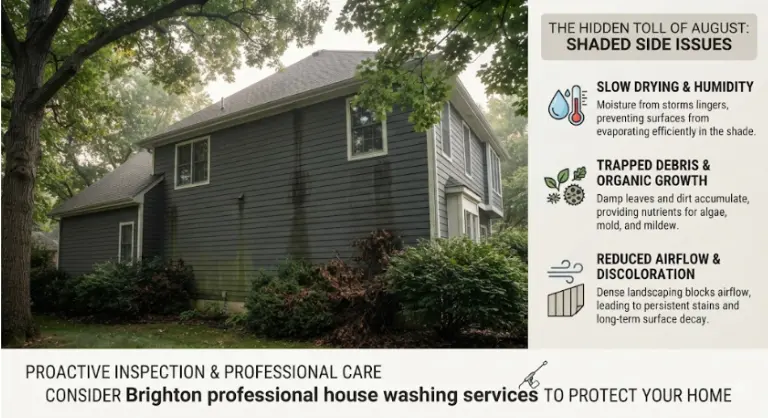
As August reaches its peak, most homeowners are focused on the sun-drenched areas of their properties. We worry about our lawns turning brown, our air conditioning units straining to keep up, and the UV damage to our decks. However, there is a silent, often ignored process happening on the other side of your house—the side that rarely sees direct sunlight.
The shaded, north-facing walls of your home endure a very different summer than the rest of your property. While the south-facing side basks in the sun, drying quickly after a thunderstorm and staying relatively clear of organic growth, the shaded side is trapped in a microclimate of its own. By mid-to-late August, the compounding effects of humidity, trapped moisture, and restricted airflow create a perfect breeding ground for problems that can damage your exterior surfaces.
If you haven’t inspected the shaded perimeter of your home lately, you might be surprised by what you find. Let’s dive into why August heat creates unique challenges for shaded exterior walls and why a late-summer inspection—often followed by Brighton professional house washing services is essential for the longevity of your home.
The Microclimate Paradox: Why Shade Isn’t Always “Cool”
It is a common misconception that because an area is shaded, it is somehow protected from the harshness of summer. While the shade keeps the surface temperature lower than that of a sun-baked wall, it does nothing to mitigate the high ambient humidity of August.
In many regions, August is characterized by heavy air, frequent humidity spikes, and stagnant conditions. On the north side of your home, the lack of direct solar radiation means that moisture stays on your siding, brick, or stucco far longer than on the sunny sides. When it rains, the water settles into the pores of your building material. Without the “baking” effect of the sun to evaporate that moisture, it lingers. This creates a perpetually damp environment, which is the primary catalyst for organic buildup.
1. The Proliferation of Biological Growth
The most visible indicator of this moisture trap is the appearance of green, black, or grey stains. In August, these aren’t just cosmetic eyesores; they are living organisms.
Algae, mold, and mildew thrive in the exact conditions present on your shaded wall: moisture, warmth, and a lack of direct UV light (which usually acts as a natural disinfectant). Throughout the summer, these spores land on your siding, find a foothold in the microscopic pores of the material, and begin to colonize. By August, what started as a small, invisible patch of spores may have expanded into a noticeable discoloration. If left untreated, this organic growth can actually begin to feed on the materials of your home, particularly if you have wood siding or painted surfaces, leading to deterioration over time.
2. Trapped Debris and Organic Matter
Shaded areas are often the areas where we plant foundation shrubs, ferns, or other shade-loving vegetation. While these add curb appeal, they also contribute to the “shading” of your home’s exterior.
These plants create a barrier to airflow. As the summer progresses, organic debris—dead leaves, twigs, grass clippings from mowing, and pollen—gets blown against the side of the house. In the sun-drenched areas, this debris dries out and blows away. In the shaded, damp areas, this organic matter sticks to the wall like a sponge. As it decays, it releases acids and traps more moisture against your siding, accelerating the degradation of your home’s exterior finish.
The August Inspection: What to Look For
Since these issues accumulate slowly over the months of June, July, and August, they are easy to overlook. You walk past the front door, the driveway, and the backyard patio, but you rarely “scrutinize” the north side of the house. Now is the perfect time to grab a flashlight and take a walk around the entire perimeter of your home.
When you perform your late-summer inspection, keep an eye out for these telltale signs:
- Fuzzy or Slimy Textures: If the siding feels slippery or looks “fuzzy,” you are dealing with active algae or mold colonies.
- “Tiger Striping”: These are the vertical dark streaks that often appear under the eaves or around window frames. They are typically caused by organic growth fueled by dirt and moisture runoff.
- Chalky Residue: If your siding looks dull or chalky, it may be an indication of oxidation—the breakdown of the paint or finish due to the combination of heat and trapped humidity.
- Plant-to-Wall Contact: Are your bushes touching the house? If you see branches rubbing against the siding or foliage pressed firmly against the wall, this is likely the origin point of your moisture problems.
Why Proactive Cleaning Matters
Many homeowners put off exterior cleaning until spring, believing that the winter is the only time the house gets truly “dirty.” However, ignoring these issues through the fall and winter can be a costly mistake.
When moisture is trapped behind organic buildup, the freezing temperatures of autumn and winter can be devastating. As water freezes, it expands. If that water is trapped beneath a layer of mold or inside the pores of your siding, the expansion can cause microscopic cracks to widen, leading to peeling paint, wood rot, or compromised caulking.
By addressing the buildup in late summer, you are essentially “resetting” your home’s exterior. You are removing the food source for mold and algae before the damp, cool months of autumn arrive. Furthermore, you are restoring the breathability of your siding materials, allowing them to dry out efficiently after a storm rather than remaining saturated for days on end.
The Value of Professional Expertise
While a DIY approach to home maintenance is admirable, cleaning the exterior of a home is a task where professional expertise makes a significant difference. High-pressure washing, if done incorrectly, can force water into siding gaps, damage fragile window seals, or strip away protective finishes.
Brighton professional house washing services utilize a specialized technique known as “soft washing.” Unlike traditional high-pressure power washing, soft washing relies on biodegradable cleaning solutions to neutralize mold, algae, and mildew at the source. The system then uses a gentle, low-pressure rinse to wash away the grime, effectively cleaning the surface without the risk of damage.
When you hire professionals, you aren’t just paying for the removal of dirt; you are paying for:
- Surface Knowledge: Experts understand the difference between cleaning vinyl, aluminum, brick, stucco, and wood. They know which detergents are safe and effective for each material.
- Safety and Efficiency: Reaching the upper levels of a two-story home is dangerous for the average homeowner. Professionals have the right equipment to reach high peaks safely.
- Preventative Care: A professional technician can spot potential maintenance issues—like failing caulk or rotting wood—that you might miss. They can offer advice on how to improve airflow around your home to prevent future issues.
Final Thoughts: Extending Your Home’s Lifespan
August is a time of transition. As the intensity of the summer heat begins to wane, we have a brief window of opportunity to prepare our homes for the changing seasons. The shaded side of your home doesn’t have to be a dark, damp, and neglected space. By conducting a thorough inspection and opting for a professional cleaning, you are doing more than just improving your home’s curb appeal—you are investing in the integrity and value of your most important asset.
Don’t wait for the signs of decay to become structural issues. Take a walk around the north side of your home this week. If you see the telltale signs of August’s humidity—the green tint, the black streaks, and the trapped debris—know that there is a solution. Reach out to specialists who can restore your home to its original luster and provide it with the protection it needs to withstand the rest of the year. Your home works hard to keep you comfortable; it deserves a little bit of care in return.