I see the same frustrating problem in almost every yard I visit. You spend hours planting beautiful flowers and trimming your bushes. Your yard looks amazing. But the moment it rains, the dirt turns into a swamp. You step outside to admire your work, and suddenly your shoes sink into the mud. You end up tracking dirty footprints straight into your clean kitchen.
A yard full of plants looks great, but without structure, it quickly turns into a messy jungle.
If you want a backyard you can actually walk through and enjoy, you need garden hardscaping. In reality, the best yards balance soft, colorful plants with solid, heavy stone. Let me show you what actually happens when we replace loose dirt with solid paths and how we build a space that stays completely clean and accessible, no matter how hard it rains.
Why Garden Hardscaping Beats Loose Stepping Stones
When people get tired of the mud, they usually drive to the local home improvement store. They buy a stack of cheap, square stepping stones and drop them right into the dirt.
They think this solves the problem. It doesn’t.
What actually happens is those loose stones sink. The ground underneath them gets wet and turns to mush. When you step on the stone, it tilts. Mud squishes up between the cracks and covers the top of the stone. Soon, your new pathway just becomes a dangerous, slippery tripping hazard.
True garden hardscaping means building a solid foundation. Instead of dropping loose pieces on the ground, we pour a continuous, solid path. A solid concrete or stone walkway physically cannot sink in one spot. It stays perfectly flat. It keeps your shoes totally dry, making it easy to walk safely through your yard right after a heavy rainstorm.
Holding Back the Dirt with Garden Hardscaping Borders
A great pathway does not just give you a place to walk. It also acts as a fortress for your plants.
If your grass touches your flower beds directly, the grass roots will constantly sneak into the soft garden soil. You will spend every weekend fighting a losing battle against nature. If you look at keeping your flower beds weed-free as a major chore, hardscaping changes everything.
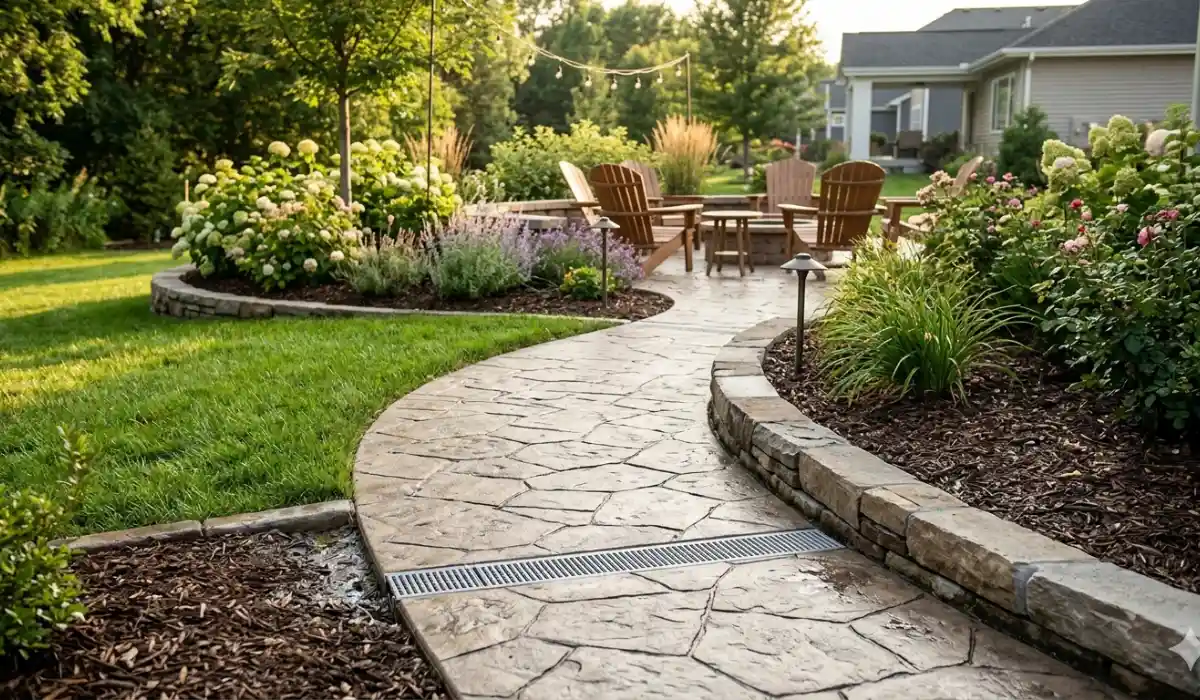
We build raised borders along the edges of the new pathways. We often use custom masonry features like stacked brick or textured stone to create a physical wall between the walking path and the garden dirt. This heavy border holds your mulch inside the bed during a rainstorm so it doesn’t wash out onto the walkway. It also blocks grass roots from invading your flowers. You get a clean, sharp line that makes the whole yard look perfectly organized.
Smart Water Flow in Garden Hardscaping
Here is a big secret about building paths. You cannot just block water; you have to guide it.
When you build a wide, solid walkway, rainwater hits the hard surface and needs a place to go. If the path sits completely flat, the water pools up and forms a giant puddle. If the path tilts the wrong way, it will dump thousands of gallons of water straight into your living room.
A professional builder always tilts the path slightly. You cannot even see the tilt with your eyes, but gravity feels it. The rain hits the walkway and rolls gently off the side, directly into the thirsty flower beds that actually need the water. For larger yards that get easily flooded, we install smart concrete patio drainage solutions directly into the hardscape. We hide sleek metal grates inside the concrete to catch heavy storm water and shoot it safely away from the house.
Designing the Perfect Destination
A walkway should always lead you somewhere special.
Do not just build a path that stops in the middle of the grass. Use your new garden hardscaping to draw people deep into the yard. We love building meandering paths that curve around large trees and eventually open up into a hidden, quiet patio area in the back corner of the property.
This creates a true outdoor living room. It gives you a clean, dry spot to set up a fire pit or focus on styling a cozy outdoor seating area without worrying about the legs of your chairs sinking into the mud.
Conclusion
You work hard on your garden. You should be able to walk through it without ruining your shoes.
Adding garden hardscaping is the smartest way to upgrade your home’s exterior. By swapping loose, sinking stones for a solid, well-drained pathway, you instantly remove the mud from your life. Add some strong masonry borders to hold back the weeds, and you will spend much less time doing heavy yard chores. You finally get a structured, clean, and beautiful backyard that you can enjoy every single day of the year.
Frequently Asked Questions About Yard Pathways
Will building a concrete path kill my large tree roots?
Not if you plan it carefully. We never cut thick, main anchor roots. Instead, we curve the pathways around mature trees. If we must go near a tree, we use a slightly elevated path design with special gravel bases so the roots can still get oxygen and water.
How wide should a garden path be?
A comfortable pathway for one person walking should be at least three feet wide. If you want two people to walk side-by-side, or if you need to push a wide wheelbarrow through the yard easily, you should build the path at least four feet wide.
Does a solid walkway require a lot of cleaning?
No. Solid hardscaping requires very little maintenance compared to a lawn or a gravel path. You just need to sweep leaves off it occasionally and rinse it with a garden hose if it gets dusty.