
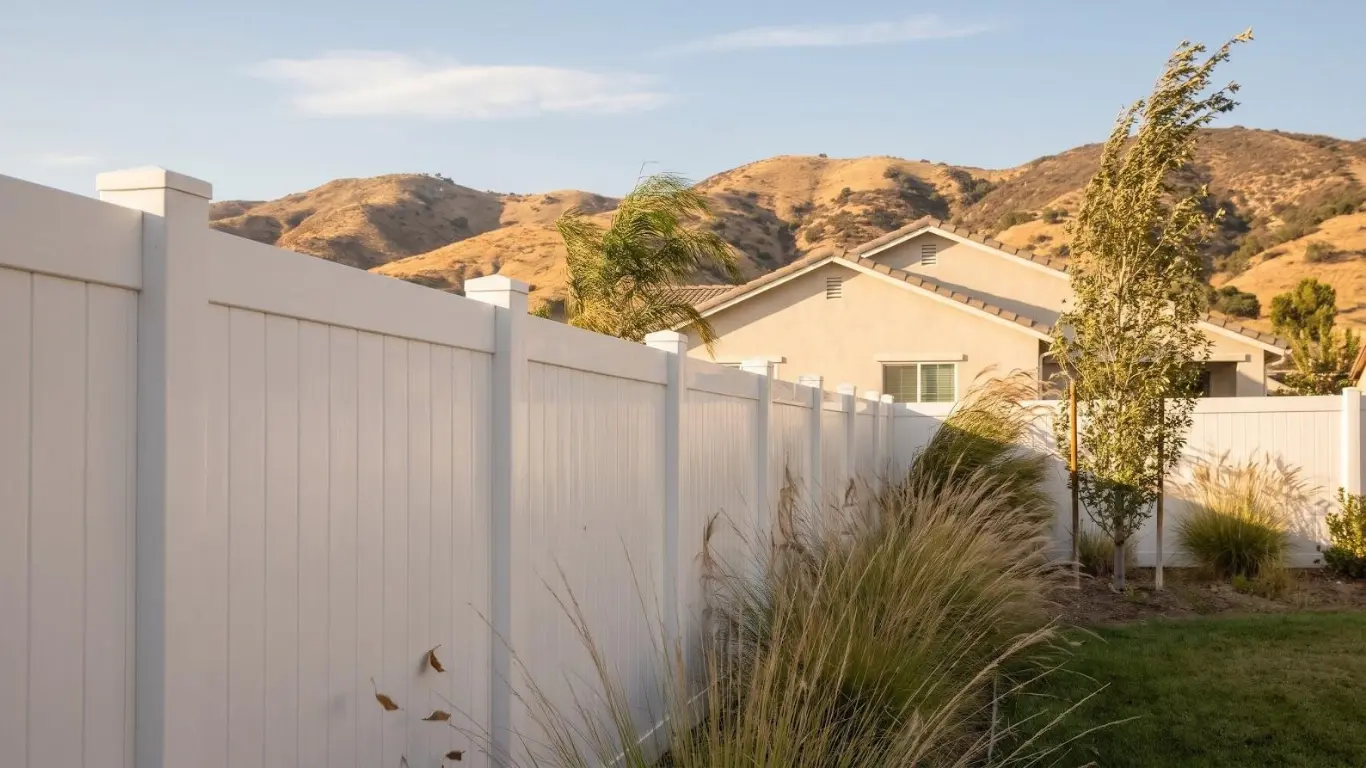
Vinyl fencing wins fans across the San Fernando Valley because it never needs paint. But “vinyl” isn’t a wind rating. Santa Ana winds (hot, downslope gusts from the desert) can slam a six-foot privacy panel harder in Chatsworth than in North Hollywood. Strength depends on the whole load path: panel, rails, connectors, post, footing, and soil. In this guide, you’ll learn how four factors (site exposure, fence openness and height, post-footing design, and local permit paperwork) decide whether your fence stays upright when the National Weather Service issues its next red-flag warning.
Why Santa Ana exposure changes across the Valley
What creates Santa Ana winds?
Cool, dense desert air builds over the Great Basin. When high pressure anchors inland and lower pressure settles off the coast, that air is funneled west through mountain passes toward the coast. As it descends, the flow warms and dries by compression, so the gusts that enter the San Fernando Valley arrive hotter and much drier than the coastal marine layer. Santa Ana winds can easily exceed 40 mph, and the January 2025 event topped 80 mph.
Why the western Valley feels the brunt
Canyons that slice through the Santa Susana range funnel offshore winds toward Chatsworth, Porter Ranch, and Woodland Hills, while the eastern Valley, including North Hollywood, is usually more sheltered.
Weather gusts versus building-code wind speed
News tickers may trumpet a 60 mph gust, yet building codes use a different yardstick: the three-second basic wind speed measured 33 ft above open terrain and then adjusted for local exposure. Your city’s building department sets that design speed for your address from the code’s wind map, so ask for the figure that applies to your lot. One storm reading cannot rewrite that legal baseline, and a product flyer that quotes a round wind figure without panel size, post spacing, and test method offers no reliable proof of strength.
Why the western Valley deserves separate treatment
Because the western zone receives stronger, more frequent gusts, installers treat a Chatsworth backyard as a high-exposure site even when a North Hollywood address just 15 mi east qualifies for a lighter design. Treat the forecast-zone line like a fault line, because it can change the required post strength and footing depth even when the fence style stays the same.
“Starts at the post” means the entire load path
A fence is a miniature structure: wind pushes on the panel, rails transmit that force into the post, the post tries to rotate at grade, a concrete footing spreads the load, and the surrounding soil finally resists overturning. If any link is undersized, the whole chain fails, even when the material is low-maintenance vinyl.
Follow the force from panel to soil
Picture wind as a steady palm pressed against the fence. The vinyl panel flexes, the top and bottom rails carry that load through routed slots or brackets, and the force concentrates in the hollow post. At grade the post behaves like a lever. A wider concrete footing spreads that load, yet its real capacity depends on embedment depth and soil shear strength. Using the basic pressure formula q = 0.00256 V², a 60 mph gust produces about 9 psf, while a 100 mph design gust drives the load to about 26 psf, nearly triple. The surrounding soil is the final link; loose backfill or poor drainage can undo every upgrade above it.
If any link, such as thin rail walls, loose connectors, or shallow concrete, underperforms, the chain fails. Judging strength therefore means tracing this full, documented path, not just admiring a rigid panel.
The variables that change post design
Height
Raising a fence from 4 ft to 6 ft enlarges the wind sail by 50 percent and roughly doubles the bending moment, because the lever arm grows with the square of height.
Spacing
Stretching posts from 6 ft to 8 ft widens the tributary panel by 33 percent, so each post must carry a third more load.
Profile and reinforcement
A structural PVC post resists bending in its own walls, while a decorative sleeve relies on the steel or aluminum core inside. Wall thickness, insert size, and the way the two interact all change capacity.
Terminations and gates
Corner, end, and gate posts add torsion, hinge weight, and repeated impact. A detail that works for mid-span pickets can fail when it must hold a driveway gate.
Soil and slope
Dense alluvium common in Van Nuys resists overturning far better than loose fill on a Northridge hillside. Drainage, retaining walls, and expansive clay can each force a deeper or wider footing.
Because these factors interact, reputable installers confirm fence style and site conditions before quoting post size or hole depth. Wind pressure itself follows the same formula q = 0.00256 V², so a 60 mph gust exerts about 9 psf, while a 100 mph gust reaches about 26 psf, nearly triple.
How deep should vinyl fence posts be?
There is no universal three-foot rule. The building code asks designers to show that the surrounding soil can resist the calculated bending moment on the post. IBC §1807.3 views embedment depth as a function of wind pressure, post size, footing diameter, and soil shear strength, not a memorized number.
A six-foot vinyl panel on a Chatsworth bluff therefore needs a deeper or wider footing than the same panel tucked behind a North Hollywood garage, even though both stand inside the Valley.
Concrete fill is another variable, not an automatic upgrade. Many vinyl systems are lab-tested with an air gap for thermal movement; solid fill can add stress and might void the warranty if it departs from the tested configuration. Always match the footing and post detail to the manufacturer’s engineering sheet for your exact panel height, spacing, and site exposure.
A local fabrication example, not a one-size recipe
Vinyl Fence Depot in Van Nuys has manufactured, fabricated, and installed vinyl fencing since 1994, using a rigid PVC compound with a high level of titanium-dioxide pigment for UV resistance. Its Custom vinyl fencing and patio covers in SoCal lineup carries a manufacturer’s limited lifetime warranty for single-family homes (30 years for multi-family and commercial sites) against peeling, flaking, blistering, rotting, and corroding, along with lifetime protection against discoloration. Because wind loads and soil conditions vary across the Valley, the company customizes and fabricates each project after a free consultation at the property, so the post and footing details can be matched to your yard’s exposure.
Apply this level of diligence with every supplier: ask for the engineering letter, confirm it matches your site exposure, and verify the footing detail that keeps each post rooted.
What a fence wind rating does, and does not, prove
Does a wind rating mean the fence meets Los Angeles code?
A wind figure on a banner or flyer is not a code approval. The residential code sets a basic design speed for each address, measured as a three-second gust 33 ft above open terrain, and then instructs designers to adjust for exposure (B, C, or D), topography, and shielding, and to apply the load to the full post-to-soil path.
Why that context matters shows up in the pressure formula q = 0.00256 V² (psf):
- At 80 mph the pressure is about 16 psf
- At 100 mph it climbs to about 26 psf, more than half again
A result from a test on one fence setup does not carry over to another. Change any variable, such as a taller fence, a wider span, or a hilltop Exposure C lot, and the safe load changes. Treat any wind number as a conversation starter: ask for the test standard, panel size, post spacing, footing detail, soil assumption, and failure criterion before deciding the fence is truly code worthy for your yard.
Fence codes change at the city line
Step one in any fence plan is to confirm which rule book applies the moment you cross the sidewalk. In the Valley that authority may be the City of Los Angeles, the City of San Fernando, Burbank, or unincorporated Los Angeles County, each with its own mix of zoning heights, permit triggers, and inspections.
City of Los Angeles
Most Valley addresses still fall under the original Los Angeles Zoning Code. In standard R zones the zoning code sets a low front-yard fence height (LAMC §12.22 C.20), and taller fences are allowed only behind the required front setback, so check your lot’s zone on ZIMAS before you order panels. LADBS requires a permit for a fence of any material other than masonry or concrete only when it is over 10 ft, yet that exemption never overrides the lower zoning height.
City of San Fernando
North of the 118, San Fernando writes its own fence rules, so check the city’s municipal code and planning counter for heights and permit triggers before you order panels.
Burbank and unincorporated county pockets
Burbank sets its own front-yard height limits and building-permit thresholds, so check with its Community Development Department before you build. Unincorporated county “islands” follow the County Code (Title 22), so confirm front- and side-yard heights with LA County Public Works before you build.
Pool barriers are a separate safety regime
California’s Swimming Pool Safety Act sets statewide requirements: a 60-inch minimum enclosure, self-closing and self-latching gates that open away from the water, latches at 60 in. above grade, and gaps small enough to block a 4 in. sphere. New or remodeled pools at single-family homes must have at least two of seven state-approved drowning-prevention features (HSC §115922), such as an enclosure, alarms, or a safety cover. Exact requirements vary by local jurisdiction (AHJ), so always verify with your local building department.
Takeaway
Codes may feel like paperwork, yet they capture hard lessons about wind, visibility, and safety. Confirm the right jurisdiction first and match both zoning height and building-permit rules, and you avoid mid-project redesigns that cost far more than a phone call to your local planning and building department.
Soil, heat, seismic movement, and wildfire can change the specification
Soil and drainage
Soil changes from one Valley lot to the next: compact alluvial sand resists a leaning post far better than loose silt-clay fill, and the building code assigns each soil class its own allowable lateral bearing value. A footing that feels rock solid in the first soil can start to rotate in the second, especially if poor drainage saturates the embedment just as Santa Ana season peaks. Design therefore begins with a site-specific soil check and a plan to keep water moving away from each post hole.
UV exposure and thermal movement
Rigid PVC expands roughly 3 to 5 × 10⁻⁵ in./in./°F. On a sunny Valley day a rail can climb 40 °F above the morning temperature, adding nearly ⅛ in. of length to a six-foot span. The formulation, including titanium-dioxide pigment, impact modifiers, and stabilizers, controls how well the profile keeps its color and impact strength under years of ultraviolet exposure.
A well-designed vinyl system therefore leaves measured clearance at each rail end and avoids gluing rails rigidly into posts. That space lets the panel expand and contract through daily cycles without bulging or popping caps.
Seismic and retaining-wall conditions
A freestanding vinyl fence can flex and rebound, but when a topper is bolted to an older block wall it inherits every hairline crack left by past shaking. Add a retaining wall and the post must resist wind pressure plus lateral soil thrust, which grows when the backfill is saturated. Those combined loads are a structural design case, not a handyman detail, and a quick check by a structural engineer is cheaper and safer than repairing a toppled wall after the next quake.
Wildfire and the coming Zone 0 rules
Santa Ana winds that stress fences can also carry embers, and vinyl can ignite if glowing debris nests against it. California’s proposed Zone 0 rules, adopted by the Board of Forestry but withdrawn from Office of Administrative Law review in September 2026 and not yet in effect, would bar new combustible fencing within 5 ft of a home and generally require a 5 ft noncombustible section where a fence attaches to the house. Until rules take effect, a practical approach is to use metal or masonry for the last 5 ft of fence next to the home, clear debris along the fence line, and keep nearby vegetation trimmed low so embers have nowhere to land.
Bottom line
Soil strength, thermal cycling, seismic motion, and ember exposure all tug the design in different directions. Address each factor before posts go in, and the finished fence becomes a calculated response, not a roll of the dice.
Vinyl versus wood, composite, aluminum, and steel
Choosing a fence means choosing a bundle of trade-offs: wind load, upkeep, aesthetics, and budget all tug in different directions. The table below compares the common options on wind behavior, upkeep, and regional caveats.
| Material/system | Wind implication | Routine upkeep | Regional caveat |
| Solid vinyl privacy | High sail area, needs engineered post/footing pair | Wash with mild soap | Thermal movement and ember exposure |
| Pressure-treated or decay-resistant wood | Solid boards catch wind but can be repaired plank by plank | Re-stain or paint every 3-5 yr, termite watch | Ground-contact treatment and drainage matter |
| Wood-plastic composite | Heavy, rigid boards demand a stout frame | Periodic washing | Creep and moisture sensitivity vary by brand |
| Open aluminum picket | Air passes through, reducing pressure, rust-resistant metal common for pool-view fencing | Occasional rinse, tighten fasteners | Lower stiffness than steel, galvanic corrosion with mixed metals |
| Tubular steel / ornamental iron | High stiffness, open designs shed wind | Inspect coating, touch-up paint | True wrought iron is rare, rust control drives cost |
| Chain link | Very low wind area | Minimal, tighten fabric and lube hinges | Limited privacy without slats |
Vinyl still eliminates paint brushes, but that perk disappears if undersized posts pull out in the first Santa Ana burst. Wood accepts spot repairs yet demands finish and fastener vigilance. Aluminum shrugs at rust but flexes more, while steel is stiff but needs diligent coating care. Chain link is economical and airy, yet privacy slats reintroduce wind pressure and upkeep. No single material is the universal champion; the best choice is the one whose weaknesses you can manage and whose strengths match your lot’s wind exposure and maintenance appetite.
From estimate to storm-ready handoff
A fence contract is more than a price; it is a promise that every post, footing, and gate will work when the National Weather Service issues its next red-flag warning.
Before you sign
Treat the pre-construction meeting like a cockpit checklist:
- Verify lot lines, HOA limits, and which party files the permit
- Confirm post spacing, footing depth, and who will request the 811/DigAlert ticket at least two working days before drilling
- Ask for the wind-test sheet or engineering letter that matches your exposure
- Get the gate-post detail and drainage plan in writing, and read the warranty (especially wind exclusions)
Before Santa Ana season
Each autumn invest fifteen minutes: clear leaves from the base so water drains, sight along the run for leaning posts or cracked footings, tighten loose caps, and lubricate hinges. Correct small issues before 40 to 60 mph gusts turn them into failures.
Automated gates add a safety layer
For a motorized driveway gate, make sure the fabricator installs edge sensors and photocells, then test them monthly.
For a closer look at job-site flow and inspections, see Grow Homely’s step-by-step guide: What to expect from professional fence installation.
Check these boxes and you will hand off a fence that is code compliant on paper and storm ready in practice.
Conclusion: buy a documented system, not just a material
Santa Ana winds ignore marketing copy. They respect only a fence whose panel, rails, posts, footing, and soil are engineered to work together. If you like low-maintenance vinyl, ask for the full engineering sheet, verify that its wind test matches your exposure, and confirm the footing and gate details before you sign. Do that homework now, and the next red-flag advisory will be background noise, not a repair bill.